

About two hours drive from Islamabad, on the road that goes towards Lahore, something surprising waits for you. You leave behind the noisy cities and enter a different kind of world. This is the Potohar Plateau, a land of dry, rocky hills. It doesn’t look soft or green. But hidden inside these rough hills is a place so beautiful and peaceful that it feels like a dream.
This place is called Katas Raj. And just a few minutes away is a small town named Kallar Kahar.
Together, these two spots tell a story that is thousands of years old. It is a story of gods crying, kings fighting, wise men teaching, and people from different faiths living in the same land. Let me take you there, in simple words.
Chakwal City: The Military Valley of Pakistan – History, Rewari, Khussa Shoes & Tourist Places
First, a Little Background
Katas Raj is not one building. It is a family of old temples. They sit around a still, green pond. The pond is the heart of this place. The temples are old, very old. Some people say they were built around 1,500 years ago. Others believe this spot has been special for even longer than that.
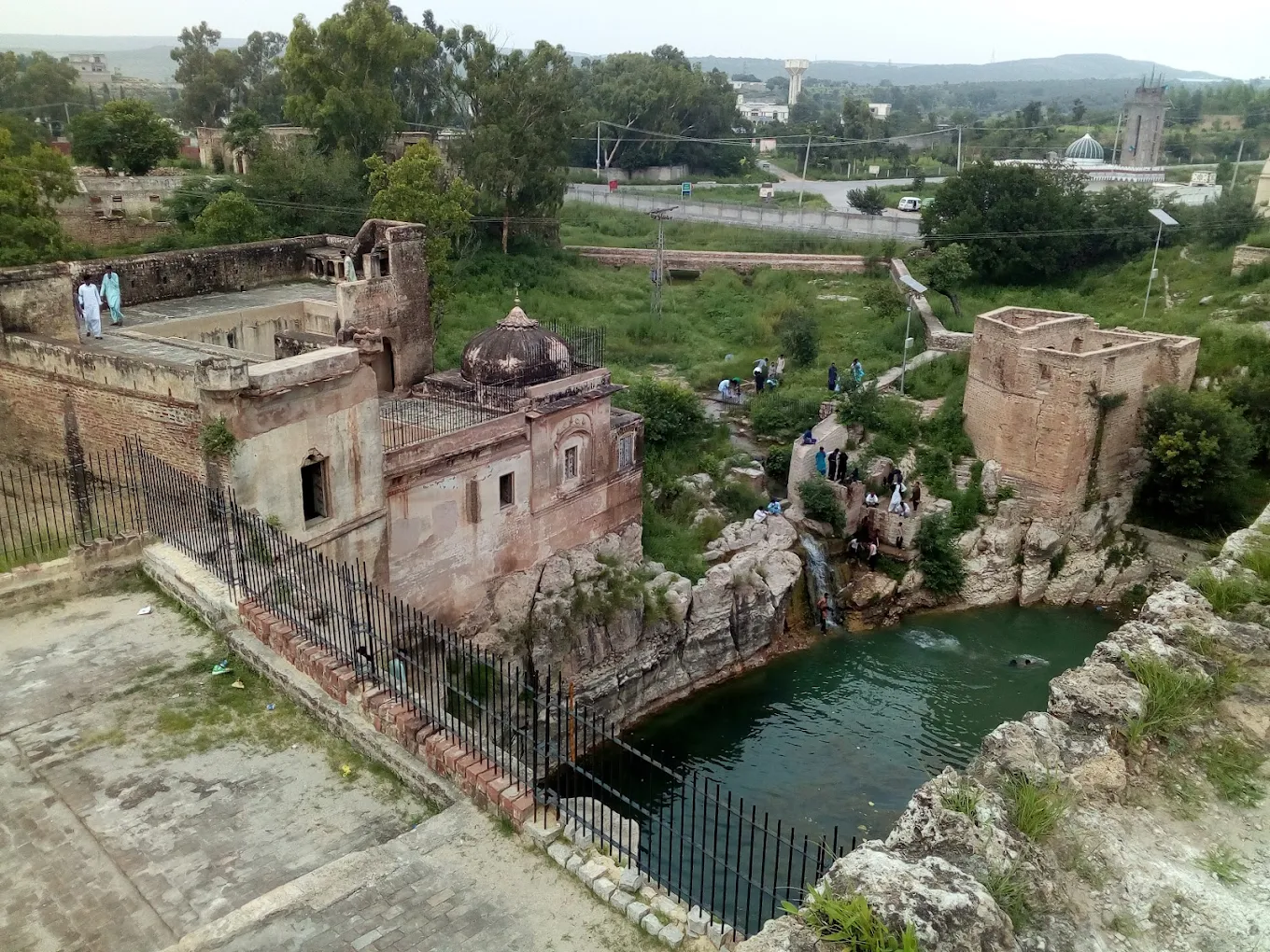
The temples are in Chakwal District, in the Pakistani province of Punjab. For hundreds of years, travelers, holy men, and pilgrims have come here. They come to pray, to think, and to feel something bigger than themselves.
Now, let’s walk through this place together.
How a God’s Tears Made a Pond
To understand why Katas Raj is so special, you have to hear the old story. It comes from Hindu mythology.
There was once a god named Shiva. He had a wife named Sati, whom he loved more than anything. A terrible thing happened: Sati died. When Shiva heard the news, his heart broke. He picked up her body and walked across the world, crying and crying. He could not stop his tears.
His tears fell on the earth. And wherever a tear landed, a pond was formed. Two ponds became famous. One is Pushkar Lake in India. The other is right here, at Katas Raj in Pakistan.
This is why the pond at Katas Raj is so holy. People believe it is not ordinary water. It is the tears of a god who lost his love. For centuries, pilgrims would come and bathe in this water. They believed it would clean their souls, wash away their sins, and bring them peace.
Even today, when you stand next to that pond, there is a strange quiet. The trees hang over the water. The old temples look at their own reflection. You don’t need to be a believer to feel that something special happened here.
The Pandavas and a Famous Riddle
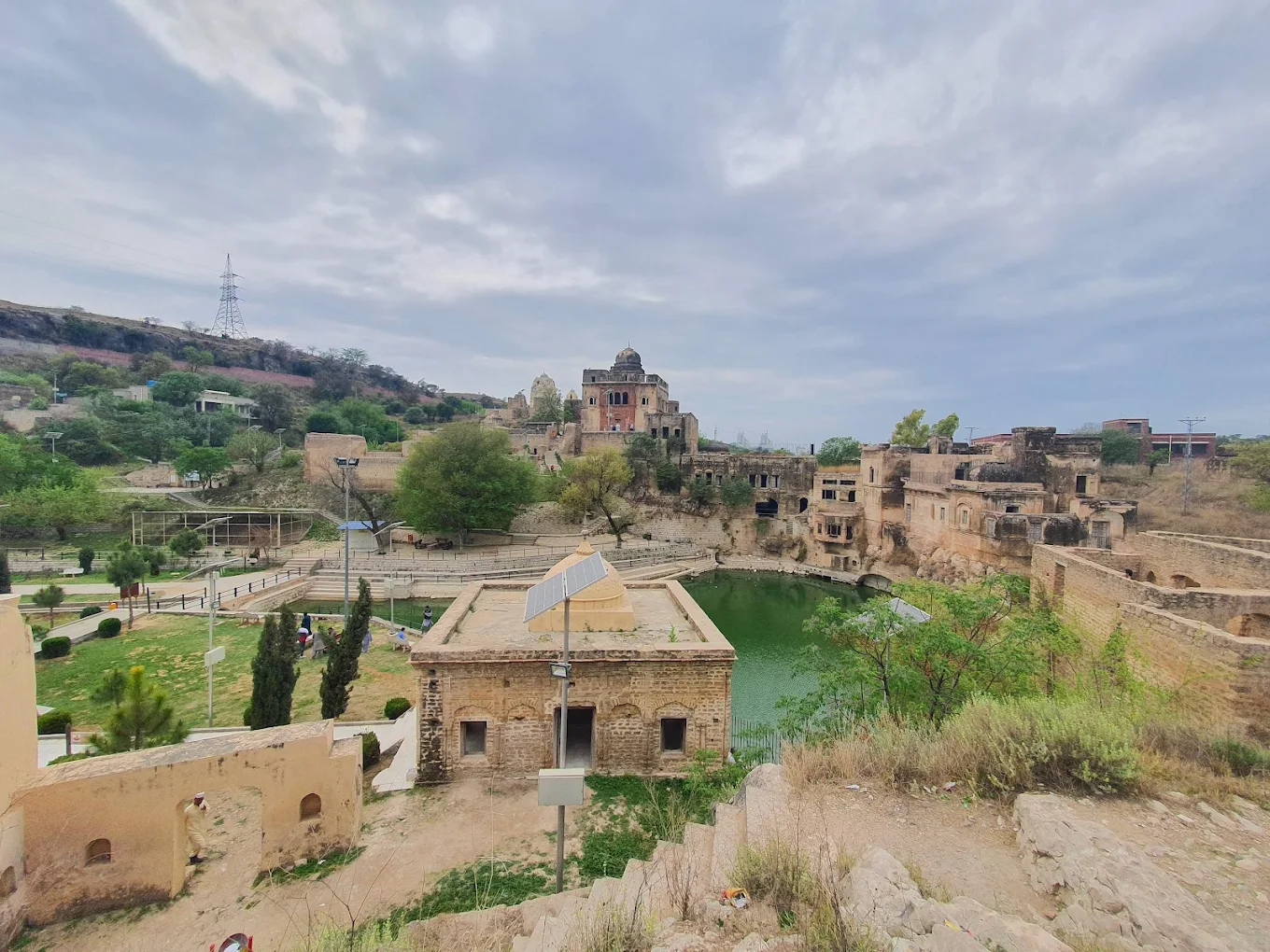
Another old story connects Katas Raj to the Mahabharata, one of the most famous epics in the world.
The story says that the five Pandava brothers were once sent away from their kingdom. They had to live in the forest for twelve years. During those years, they visited many holy places. One of those places was Katas Raj.
There is a beautiful story about a pond and a riddle. One day, one of the Pandavas, a very wise man named Yudhisthira, came to this pond to drink water. But a spirit, called a Yaksha, stopped him. The spirit said, “Answer my questions first. If you fail, you will die.”
The spirit asked many hard questions. He asked about wisdom, about patience, about right and wrong. Yudhisthira answered each one perfectly. He was so wise and humble that the spirit was pleased. The spirit then brought Yudhisthira’s dead brothers back to life.
So this pond is not just about sadness. It is also about wisdom. It is a place where a human proved that knowing the truth is more powerful than any magic.
A University for Wise Men?
Here is another interesting part. Some historians believe that a long, long time ago, a university stood near these temples. Yes, a university, more than two thousand years back.
They say a famous teacher named Chanakya (some call him Kautilya) might have taught here. Chanakya was a very clever man. He wrote a famous book on politics and economics. He helped a king named Chandragupta Maurya build a huge empire.
Is it true that Chanakya actually taught at Katas Raj? We are not 100% sure. Historians still argue about it. But the fact that people even talk about it tells you something. This was not just a religious place. It was a place for learning, for smart people to share big ideas.
The Buildings That Speak
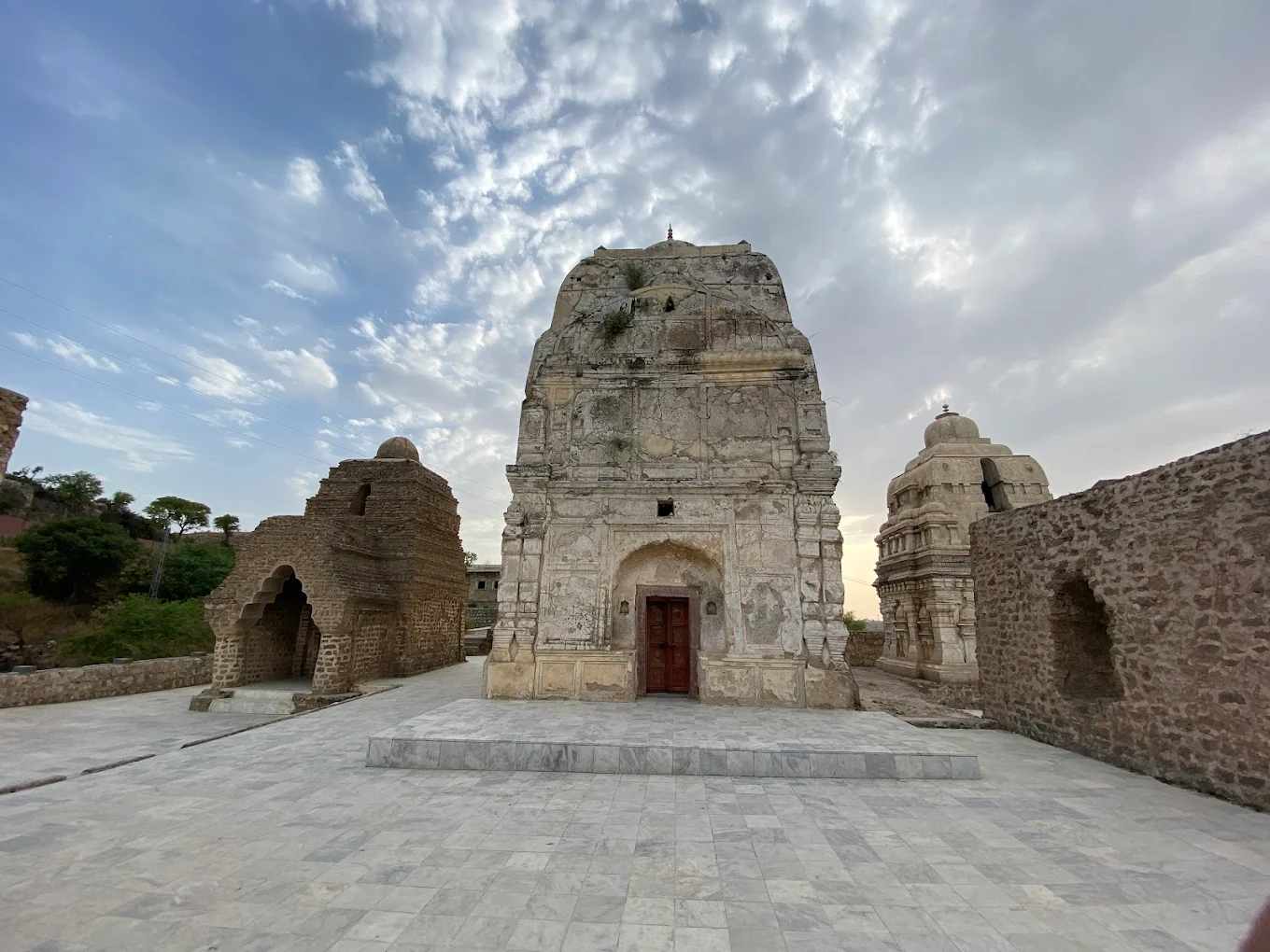
Now let’s look at the temples themselves. They are made of local stone. Time has not been kind to them. Some walls have crumbled. Some carvings have faded. But what remains is still beautiful.
The temples are a mix of two styles: Kashmiri and Gandharan. Kashmiri style uses wood and stone in a special way. Gandharan style came from the Greeks and Persians who lived in this area long ago. Mixing them together created something unique.
The main group of temples is called Satghara. That means “seven houses.” Once there were seven temples together. Now only five are fully standing. They are small, but they feel strong. You can walk inside them, touch the old stone, and wonder about the people who prayed here a thousand years ago.
One temple is for Lord Rama. One is for Lord Hanuman, the monkey god. Another is for Lord Shiva. Each one has a different feeling. Each one tells a different part of the same long story.
The Sikh Emperor Who Came to Pray
The story of Katas Raj does not end with the Hindu kings. Later, during the Sikh Empire, this place was still loved.
Guru Nanak, the founder of Sikhism, is said to have visited here. And Maharaja Ranjit Singh, the famous one-eyed Sikh emperor, also came. He came during a spring festival called Vaisakhi. He prayed at the temples. He respected the pond.
A famous Sikh general, Hari Singh Nalwa, built a small fort and a mansion here. You can still see them today. They remind us that holy places do not belong to just one religion. They belong to everyone who respects them.
Getting to Katas Raj & Kallar Kahar (Very Easy)
One of the best things about this place? It is not hard to reach at all. The roads are good, and the drive is beautiful.
From Islamabad (about 120 km)
Take the M2 Motorway toward Lahore. Get off at the Kallar Kahar Interchange. From there, drive about 20 to 25 minutes toward Katas Raj. Total time is around 2 to 2.5 hours. Easy.
From Lahore (about 240 km)
Take the M2 Motorway toward Islamabad. Exit at Kallar Kahar. You will be there in 3 to 4 hours. A perfect day trip if you start early.
From Rawalpindi (about 110 km)
You can take the M2 Motorway or use the Grand Trunk Road via Chakwal. Either way, it will take about 2 to 2.5 hours.
From Peshawar (about 250 to 270 km)
Drive to Islamabad first, then hop on the M2 Motorway. Total travel time is around 4 to 5 hours. Longer, but worth every minute.
Kallar Kahar – The Quiet Neighbor
If you get tired of old stones and temples, you can drive just ten minutes to Kallar Kahar. This is a small town, but it is very pretty.
Kallar Kahar Lake is a peaceful saltwater lake surrounded by hills. The water is calm. You can rent a small boat and float around. In spring, the area becomes lush and green. Many families come here for picnics.
Around the lake, you will see peacocks. Lots of peacocks. They walk around freely, showing off their blue and green feathers. If you are lucky, you might see one spread its tail like a giant fan.
There is also Takht-e-Babri, which means “Babur’s Throne.” Babur was the first Mughal emperor. He came from Central Asia and marched toward Delhi to start his great empire. People say he stopped here and stood on this platform to talk to his army. From up there, you get a panoramic view of the Salt Range hills. Absolutely beautiful, especially near sunset.
Other Nearby Places Worth Seeing
If you have extra time, or if you just love exploring, here are some other spots close by:
Malot Fort – This is an ancient fort near Katas Raj. It shows the beautiful Hindu Shahi style of building. It is less crowded than other places, so if you like quiet historical walks, you will love this.
Soon Valley – About one hour away from Kallar Kahar. This valley is full of lakes, waterfalls, and hiking trails. Three spots inside Soon Valley are especially nice:
- Uchali Lake – Famous for birds that travel from faraway countries. Very pretty.
- Khabikki Lake – Also scenic, but less crowded. Good for peace and quiet.
- Sakesar Mountain – The highest point in the area. The weather is cooler here, and the views are amazing.
What to Eat Around Here
Kallar Kahar is not a big food city. Do not expect fancy restaurants. But that is okay, because the simple food here is often the best.
Must-try foods:
- Saag with Makki di Roti – This is a winter special. Cooked green leafy vegetables eaten with a flatbread made from corn. Very Punjabi. Very tasty.
- Chicken Karahi – Spicy chicken cooked in a iron pan. A road trip classic.
- Chapli Kebab – If you are coming from the Khyber Pakhtunkhwa side, you will find these. Spicy, flat beef kebabs. So good.
- Lassi – A sweet or salty yogurt drink. Perfect for hot days.
The small roadside dhabas (simple eateries) near the motorway and the lake serve the freshest meals. Do not skip them.
Interesting Things to Do
Explore the ancient temples – Walk through the whole Katas Raj complex. Notice the mix of Hindu and local building styles. Early morning visits are the best. Fewer people, cooler air, and a magical quiet.
Take photos – The contrast between old stone temples, greenish-blue pond water, and dry rocky hills makes for stunning pictures. Even a phone camera will give you beautiful shots.
Watch wildlife – Kallar Kahar is known for peacocks and other local birds. Look around the lake and the hills. Bring binoculars if you have them.
Have a picnic – Many Pakistani families visit for a day trip. Bring some snacks, sit by the lake, and just relax. No rush. No schedule.
Watch the sunset – Sunsets over the Salt Range hills are something else. The best spot is from a high place like Takht-e-Babri. The sky turns orange and pink. The hills turn dark. It stays in your memory for a long time.
A Few Travel Tips (So You Don’t Struggle)
- Best season to visit – October to March. The weather is cooler and much more pleasant.
- Summer warning – If you come in summer, it gets very, very hot. Plan your visit for early morning or late evening.
- Carry water – Always bring your own water bottles. It can get dry here.
- Bring cash – There are very few ATMs around. Cards may not work at small shops or dhabas. Keep some cash in your pocket.
- Respect the place – This is a holy site for many people. Speak softly. Dress modestly. Do not litter.
Hard Times for a Holy Place
But not everything has been good. For many years after 1947, when India and Pakistan became separate countries, this place was forgotten. The pilgrims from India could not come anymore. The water in the pond started to go down. The temples cracked and crumbled.
Why did the water go down? There are big cement factories near Katas Raj. They use a lot of water from the ground. Also, people planted eucalyptus trees around the pond. Eucalyptus trees drink a huge amount of water. Slowly, the holy pond started to dry up.
It was a sad time. Visitors would come and see mud instead of water. The very heart of the place was dying.
People Came to Help
Then, someone noticed. Historians wrote about it. Journalists came and took pictures. The courts got involved. The Supreme Court of Pakistan asked the government to do something.
In 2006, a big cleaning project started. They cleaned the pond. They repaired the broken temples. They put up signs explaining the history. The cement factory was told to reduce its water use. The eucalyptus trees were removed. And slowly, like a sick person getting better, the pond filled with water again.
Today, the pond is not completely full like in old times. But it is much better. And the work continues. The government has a special board called the Evacuee Trust Property Board. Their job is to take care of holy places like this.
Sometimes, Hindu pilgrims from India are given special permission to come here. They come during the festival of Maha Shivaratri, a night dedicated to Lord Shiva. They walk around the pond, pray in the temples, and sometimes cry. For them, this is not just history. This is their heart.
Why Should You Visit?
Maybe you are not a pilgrim. Maybe you are not a historian. Maybe you are just a normal person who likes to see new places. You should still come to Katas Raj and Kallar Kahar.
Here is why:
For the peace – The pond at Katas Raj is so quiet. You will forget your phone, your work, your worries. You will just stand there and breathe.
For the history – You are walking where emperors walked, where gods cried, where wise men taught. That is a strange and beautiful feeling.
For the peacocks – Peacocks at Kallar Kahar are not shy. They will walk right past you. It is a simple joy, but a real one.
For the drive – The road is good and smooth. In a few hours, you go from a busy city to a silent, ancient world.
For the mix – You get mythology, history, nature, wildlife, and good food all in one trip. That is rare.
A Simple Ending
Katas Raj is not a fancy place. There are no big hotels right next to it. There are no neon lights or loud music. It is just old stones, still water, and a deep quiet.
But that is exactly why it stays in your memory. You leave this place feeling different. Lighter, maybe. Or smaller in a good way – like your problems are not as big as they seemed.
In a world that moves too fast, Katas Raj asks you to slow down. It asks you to sit by a pond made from a god’s tears, look at a thousand-year-old temple, and just be.
That is its magic. Simple, quiet, and lasting.
So next time you are driving on the M2 motorway, take the Kallar Kahar exit. Spend a few hours at the temples. Feed the peacocks. Breathe the salty air of the hills. Eat a hot chicken karahi at a roadside dhaba. Watch the sun set over the Salt Range.
And think about all the people who stood in that same spot, looking at the same water, feeling the same peace, for thousands of years.
Some places are just worth visiting. Katas Raj is one of them.
Discussion